From Left to Right: Painting Madonnina by Roberto Ferruzzi (1897) and Photograph of Pop Artists Lady Gaga and Selena Gomez (2017)
There is this age-old question about whether or not art imitates life or if, conversely, life imitates art. This blog has not only been an introduction to humanities, or a strict analysis of artworks spanning across an endless list of time periods, genres, and mediums. At the heart of every post, there has been the articulation of relentless truths about the human condition. Quite simply, there has never been a dissertation about art on here that was not unwoven by philosophies, be it surrounding love or growth or revenge or unabashedfreedom.
To me, there is no debate or discussion needed. Life and art are part of a symbiotic relationship. At the most basic of reasonings, both are created by collective behaviors and actions of human beings. A painting needs a painter to manifest in the same way a first kiss can only happen when two people command their lips to interlock. At its most introspective, life and art are constantly imitating each other, as I have come to learn; they are perpetually enriching and challenging their own set of standards and expectations.
i. life: an art-inspired piece
500 Days of Summer (2009)
Abandoning the term imitation almost completely, a much better-suited word for life and art is inspiration. What we do in our lives is constantly inspired by the art forms that leave long lasting impacts on our mannerisms, ideologies, and aesthetics. My time with Hamlet has deepened my appreciation for Shakespeare and his influence over the modern phrases we integrate in our everyday conversations. When you tell your friends about your bizarre plans to get out of jury duty? “There’s method in my madness”(Hamlet, 1602), you assure them. Or if your ex-girlfriend’s fiancee looks like a Gremlin to you, your mother might accuse you of possessing the “green-eyed monster” (Othello, 1604). Language is our major tool in life, and art has had its hand in not only expanding our vocabulary but also adding emphasis to our dialogue.
Art slips new and improved words off of our tongues, yes, but it also develops our sense of empathy, critical thinking, and open-mindedness. Think of your favorite childhood book, movie, or film. In what ways has it changed you? Chances are it has in some way, at least, even down to your sense of humor (almost entirely certain mine comes from the bizarre monstrosity that is Rugrats, but I digress). The point is, our ideas of beauty and culture and entertainment are mirroring works of art. Art inspires us to lead an unapologetic, creative, and meaningful life.
Without art, life would just be a means of survival with human connection solely based out of necessity.
“Life is creation – self and circumstances, the raw material.”
Dorothy Richardson
ii. art: a life-inspired piece
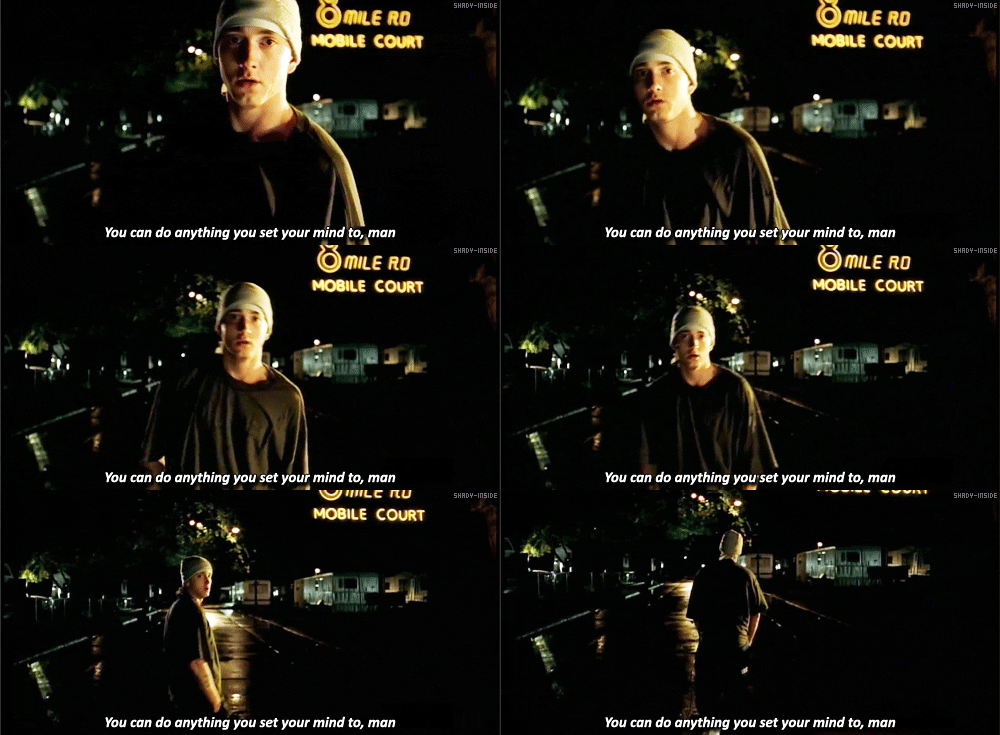
“Lose Yourself” by Eminem (2002)
A symbiotic relationship would not be symbiotic if only one organism benefitted. With that being said, art’s entire backbone is constructed out of experience and emotion. The desire to create is born out of a desire to express the varying compartments of life. Art is the capturing of life’s poetics and breakdowns. Life is natural and effortless and often painful and art is manically basing itself off of it. It is even about what is necessary, like architecture and interior design. Or prototypes for new technologies to improve the quality of life for humanity. We need art for expression, redemption, or comfortability.
Remember how a painting needs a painter to manifest? Well, a painter needs an idea before they can even whip out a canvas. They need to fall in love or something, you know? Like, travel somewhere new for the first time or learn a new language. Get married. Have a kid. Or they can simply just pass an attractive stranger at the train station. The point is, art does not just appear. It takes experience. It takes emotion. It takes a life.
When a certain phenomenon in culture exists long enough, it’s quite easy to forget there was ever a first of its kind. I can’t precisely explain why this is, or what type of era-related dementia factors into this, but I do know its affect and how powerful this distance is on our perspectives. Keeping that in mind, I’ve never really batted an eye at music videos. I was born in the late 90s, and grew up in an MTV era where new pop singles were almost always accompanied by some overly-produced video (“Hit Me Baby One More Time,” for example). To be honest, that is probably why I was instantly pulled into Devo’s Jocko Homo. I expected familiarity. I knew these art forms were experimental, but I think subconsciously at this point any type of video seems second nature to me.
As I would quickly find out, this is not true at all. Jocko Homo has me full of contradicting emotions and interpretations, and honestly that is much cooler than the simple, narrative-built, lyric-based music video I am accustomed to. It feels as if the words come from the video and not the other way around, if that makes any sort of sense. In a bizarre fashion, the video begins with a (child? mutant? doll?) character known as Boogie Boy hurrying towards his father (the president? the colonel? the dictator?) with declassified information about devolution. The rest of the three minute-and-fifty-three-second video is revolves around eccentricity. The band members, in swimming goggles and pantyhose masks, repeatedly ask “are we not men?” and respond “We are devo.” They are surrounded by onlookers in a college classroom in normal attire, wearing normal clothes and surgical masks suggests preventatives against the spreading of the so-called ‘devo.’ There are vibrant colors and funky beats and neons and freedom.
The music video can say a lot of things. It can be a satirical take on the idea that Devo and others like them are actually becoming less human and less unique in a society of suits and ties and normality. It could be a point of resistance, to suggest that ‘devo’ is actually something to strive to become. To be different in the face of overwhelming conformity in corporate America. It can be new wave and quirky. A fun video to defy all preconceived ideas about what art can be, what music can be, and who people can be. With all things considered, Devo’s art project became much more than an art project. It’s the birth of punk, music videos, and the infusing of both to create dialogue on much needed commentary. It is a reminder that we should always reflect on the first of its kind, just in case we lose the magic.
Act I, Scene V of Shakespeare’s Hamlet epitomizes the classic Shakespearean tropes of tragedy, reversals, and, most notably, revenge. In this scene, our protagonist Hamlet is confronted by the ghost of his late father. He reveals to his son (and unbeknownst the audience) that his death was committed at the hands of Claudius, young Hamlet’s uncle, to become the king of Denmark himself. The plot thickens, and we find out that Hamlet’s mother’s relationship with Claudius, her former brother-in-law, began even before his father died, establishing his mother’s adultery (and borderline incestuousness).
“But know, thou noble youth,
the serpent that did sting thy father’s life
now wears his crown.”
Hamlet, Act I, Scene V, Lines 38-40
one: the literature.
Essentially, this pivotal scene establishes the conflict for the rest of the work. The ghost motivates (as well as verbally encourages) Hamlet to avenge his death and murder Claudius, and the prince promises to do so. While their conversation occurs unnoticed, Hamlet’s friends Horatio and Marcellus were still present when the ghost of his father appeared. Under these circumstances, Hamlet (alongside the echoes of the apparition he encounters) ensures that Horatio and Marcellus swear to secrecy and essentially pretend Hamlet has lost his mind to the rest of Denmark.
Shakespeare’s wordplay and metaphors are what signifies his works. There is absolutely no exaggeration when I say he is the pioneer of modern literature, and, dare I say, the pioneer of colloquial expressions in the English language. A lot of people find his flamboyance with words redundant and unnecessary; however, throughout all of the Shakespearean plays I have read his embellishments and liberties with English are what fleshes out both the plot and the characters.
Hamlet Act I, Scene V reflects this prowess no differently. In this scene, we see the effects this revelation has on Hamlet and his personal growth through his soliloquy after the ghost exits. Shakespeare makes it clear its profoundness by having Hamlet verbally declare a major shift in his priorities from the childish to the dire in the upmost metaphorical way:
“Yea, from the table of my memory I’ll wipe away all trivial fond records. All saws of books, all forms, all pressures past that youth and observation copied there. And thy commandment all alone shall live within the book and volume of my brain.”
Hamlet, Act I, Scene V, Lines 98-103
two: the stage.
While there is no doubt in my mind that before all else Shakespeare’s Hamlet is a literary trailblazer, there is a very obvious reason why it has been adapted to the stage so many times: the heart of Hamlet is at the theater. The stage adaptation that I viewed was not a ‘better’ version than a written Hamlet, but instead a highlighted one. The contrast between the dark background and the spotlight on the ghost emphasizes the magnitude of this exchange and what it serves to both the plot and Hamlet character-wise. Dialogue is also much more livened on the stage when a human being taps into the minute details like body language, tone, and verbal emphasis. Shakespeare’s words do well on their own, but it is extremely important to understand that the stage unveils these words in ways that only the stage can. In the words of Shakespeare himself in his play As You Like It,
“All the world’s a stage, and all the men and women merely players: they have their exits and their entrances; and one man in his time plays many parts, his acts being seven ages.”
‘I really hope that those guys don’t kill those police, because it will mean more police will come. Possibly even Christians, which is totally the last thing we need in this house.’
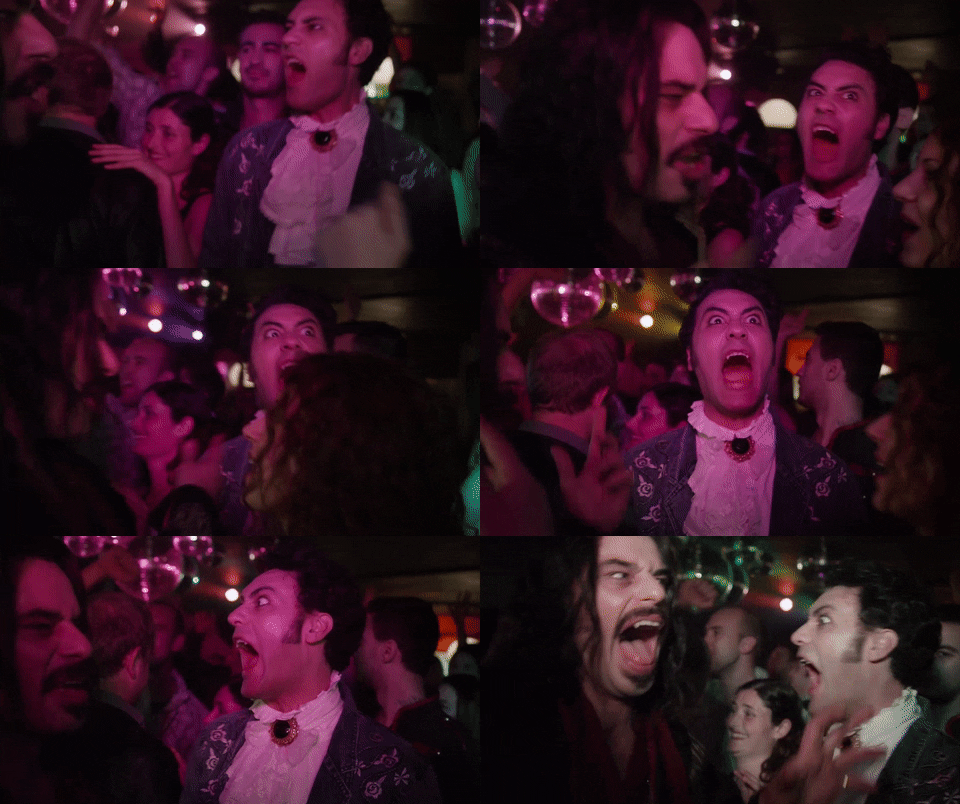
What We Do in the Shadows (2014)
What We Do in the Shadows, written and directed by Jemaine Clement and Taika Waititi in 2014, is a mockumentary archiving the (eternal) lives of four vampire roommates in New Zealand as they adjust to modern society. (The human filmmakers were ensured their protection and were provided crucifixes for extra security.) The film is relatively fast pace, with long pauses after tongue-in-cheek dialogue for humorous effect.
It’s best to explain much of the movie’s premise by character arcs, as the production of What We Do in the Shadows is based around testimonials and historical backgrounds:
Petyr is 8,000 years old. He’s very aloof considering his age and overall demeanor. Vladislavbecame a vampire at 16 during the medieval times, and expressed copious amounts of tyranny and violence. That was before, however, he suffered humiliation from his nemesis The Beast who turns out to be his ex-girlfriend Pauline.Viago became a vampire in the 18th century, resulting in his pompous attitude. He fell in love with a girl named Katherine who was emigrating with her family to New Zealand so he went with his heart and followed her there. A mistake by his servant Phillip resulted in his arrival 18 months later where he discovered she already had found someone else. In the last scene, it is disclosed that Viago’s visit to Katherine’s retirement home resulted in him biting her and ultimately turning her into his (eternal) life partner. Deacon is the youngest and the “bad boy” of the group. He was a vampire Nazi during World War II. He has a human ‘slave’ named Jackie who does all of his chores, in hopes that one day he will give her eternal life. Jackie, at the request of Deacon, brings assumed virgins Nick, her ex-boyfriend from when she was twelve, and Josephine, a former friend to the flat. It’s a dinner party that ends in the death of Josephine and the conversion of Nick. Nick becomes a roommate to the other vampires upon his conversion by Petyr. Nick comes out as a vampire to his human friend Stu, who is cool with it and the other vampires actually take a liking to him as he stays around the house. Stu introduces them to new technologies, like texting and webcams. Because of Nick’s loose lips, he lead a vampire hunter to the house who inevitably exposes Petyr to sunlight, killing him. He is banished from the flat due to his irresponsibility. Human Stu appears to be killed, but at the end of the movie it is revealed he was instead converted to a werewolf. The film ends with this reveal, as Nick shows up at the flat with Stu and his pack. They end up settling their differences and enjoy each other’s company.
ii. Synopsis of Moonlight
‘Running around, catching a lot of light. In the moonlight, black boys look blue. You blue, that’s what I’m gonna call you: Blue.’
Moonlight (2016)
In this visually stimulating, candid coming-of-age drama, Moonlight (2016) invites us on the turbulent journey through Miami-native Chiron’s upbringing. Writers and directors Barry Jenkins and Tarell Alvin McCraney construct a three-tier system to tell this story, with subsections i. Little, ii. Chiron, iii. Black detailing Chiron’s childhood, adolescence, and adulthood respectively. The film’s narrative relies on the chronological stages of life, but, with the presence of previous scenes bleeding into later stages the director makes clear that our experiences have a long-lasting impact.
i. Little: The movie begins with an introduction to Juan, a drug lord of sorts, who pulls up in a classic car to one of the designated dealing areas. The fact that this is the first person we are shown emphasizes the impact Juan has on shaping Chiron. Young Chiron running from bullies, leading him into a drug hole. This is where he first meets Juan, who is clearly concerned that Chiron is not only by himself, but also because of where he is. Juan takes Chiron to a diner, attempting to get any information out of him that he can so he can bring him home. Chiron is basically mute, a common theme throughout the movie, so Juan decides to bring him to his home. At Juan’s house, we are introduced to Teresa, Juan’s long-term girlfriend. It is no mistake that this character is named after the global symbol of humility and peace, Mother Teresa, because she exudes unconditional care. Chiron eventually opens up, but informs them he’d rather stay the night there. He ends up doing just that, paving the way for a blood bond with these two characters that develops over time. Chiron’s a latchkey kid and has learned to be independent from a young age. Juan essentially takes Chiron, or Little, under his wing, teaching him how to swim and be true to himself, amongst other valuables. We learn alongside Chiron that his mother, Paula, not only is a drug addict, but also a regular customer of Juan’s. This obviously blurs the lines of purity between the two in Little’s head, which is of course fueled by his manipulative mother.
ii. Chiron: Chiron’s teen years are climatic in every sense of the word. We first find out that Juan’s dead, which is obviously enough turmoil on its own. Paula is exponentially spiraling out of control with her addiction, resulting in a much more strained relationship with her son where she scalps Chiron for drug money through force and manipulation. Teresa is still very much in his life, offering him some sort of safe haven. She continues Juan’s legacy by infiltrating pride and joy in Chiron. Chiron is still getting severely harassed by his classmates, however, causing tension in both his school and home life. Feeling lost, Chiron takes a train to the center of peace: the beach. There he encounters his longtime friend Kevin, who calls him Black, and they experience a moment of intimacy, connection, and sexual exploration. Here, Chiron is directly confronted with his true desires and means for happiness. For a moment our protagonist has hope, but unfortunately this does not last very long. Chiron’s primary bully coerces Kevin to beat up whoever he points at, and this ends up being Chiron. He assaults him until blood spills, resulting in unbearable internal confusion, anger, and despair. This deadly combination leads Chiron to attack his bully, barging into class and hitting him over the head with a wooden chair. This subsection ends with Chiron being lead away by the police.
iii. Black: The last portion of the movie we see a drastically different Chiron, who has bulked up during his jail time in Atlanta. ATL is where he tried building himself from the ground up, becoming very similar to Juan in many ways, including his involvement in trapping. He returns to Miami because of persistent calls from his mother, who is in rehabilitation, but especially because of one call from Kevin, who he hasn’t seen in over a decade. Kevin informs him that he has a diner, and he learns that Kevin also has a child when they finally meet. He has an extremely cathartic reunion with his mother, who apologizes for her wrongdoings. He drives his classic car on the highway toward Kevin’s location as the wide shot overlaps with black children playing in the ocean in the moonlight, symbolizing his return to innocence. Chiron and Kevin catch up over wine and food at Kevin’s diner. Kevin reveals that he called Chiron after a customer played the Hello Stranger by Barbara Lewis, unlocking his pining and love for the man he endearingly called Black. Despite their gruesome fallout, the two have a deep connection and a lovely reunion, and Chiron comes back home with Kevin. The final moments of Moonlight occur seconds after the two enter Kevin’s home, where they have a heart-to-heart. Kevin questions Chiron and his truthfulness with himself, leading to his honesty that Kevin was the “the only man who has ever touched” him. Kevin consoles Chiron, and the last shot we see is a young Chiron standing in front of the shore. The only light casted is the moonlight.
iii. the anatomy of a scene: “you’re the only man who has ever touched me”
There is no better scene to dissect than the closing shots of Moonlight, for the ending is equated to a sigh of relief from years of oppression. To best analyze this scene it is best to understand another major character throughout the film: the color blue. Blue is literally everywhere, from the water to the cars to the walls to the costume design, and even specific dialogue geared to the color. It is a symbol of both childlike innocence and a peaceful state of mind, something Chiron had been desperately searching for his entire life. With that being said, in this closing scene, Chiron finally finds his blue. After Chiron reveals to Kevin that he was “the only man who has ever touched” him, he appears as anxious and timid as always, but it is very clear something drastic has changed. A lifelong weight lifted. He exhales, his eyes begging for approval from Kevin. The camera cuts to a wide shot, and a very important one I might add. The two men are facing each other, and on the wall in between them are drawings which I assume are from Kevin’s child. The drawing on Chiron’s side depicts a shark jumping out of water, into the sun, above black sand. This represents Chiron and his facade of hardness used to survive his dark, murky life. He had to be ferocious, or at least he thought he had to be. Next to Kevin is a large sunrise rising over waters and forestry, representing the Bob Marley carefreeness Kevin tells Chiron he’s living by. The two drawings are connected by home, cementing the fact that Chiron and Kevin were supposed to come together for both of their sakes. The next shot, Kevin smiles facing the camera, further proving that Chiron has come ‘home’ meaning that he is finally living his truest and best life. Kevin’s blue shirt, and the following scene where Kevin is holding Chiron, prove that Kevin is the one to finally bring him to become like the ocean: effortless and unapologetic. The final shot of Moonlight, where a young Chiron faces his back towards the camera and his eyes towards the moonlit ocean provide the cinematic equivalent of achieving full circle. When young Chiron turns his head and looks at the camera in the final shot, it allows the audience to understand he has finally found his childlike wonder and freedom despite the violence surrounding him. As the older Cuban woman Juan experienced in his youth said so eloquently, “In the moonlight, black boys look blue” (Moonlight, 2016). In the moonlight, black boys defy adversity, stereotypes, and the expectation built around them to fail.
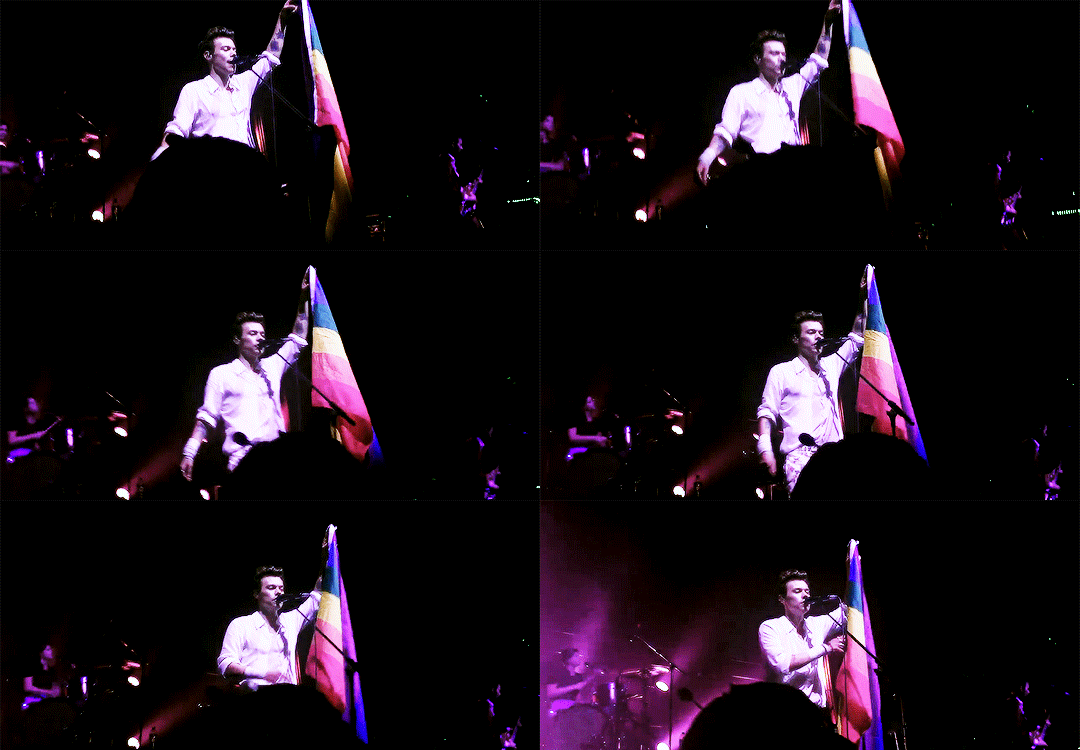
“Queer Musician and Former One Direction Band Member Harry Styles Holding Up a Pride Flag”
The LGBTQ+ Rainbow Flag has been in existence since 1978, when it was first invented by San Francisco artist Gilbert Baker. Since then its maintained its pride and positivity, permanently cementing itself as a counterattack towards discrimination and hate. Not many people may be aware of this, but each color in Baker’s flag symbolizes crucial elements and values that transcend the queer community: Red is for life, orange is for healing, yellow is for sunlight, green is for nature, blue is for harmony, and purple is for spirit. For my photographic collection, I decided to find these colors in everyday objects to establish what should already be very clear: no matter our race, sexuality, or gender, we are all unified by the same human experience.
“life.” There is a special kind of red found here, an overwhelming expression of vibrance and existence that screams, “Stop and smell the roses.” (Which, coincidentally, are also red.) Life is not about moving fast, or counting days on a calendar. Life is stopping, contrasting the blues (like the sky in this photo) with a red bright enough to infuriate a bull. Not to be redundant, but life is about living.
“healing.” Amongst all of the photos I took for this collection, this little gem has to be my favorite. Not only does this image represent the orange of the pride flag, but it also represents even more so its symbolism of healing. There is a cathartic presence that comes from the goldfish. It may be a still shot, but you can feel the tranquil, effortless movement of fishes. This is how we all heal. It is fresh and about release. Healing is continuous and unified and baptizing. It is adaptation and self-care. Orange fits goldfish so well because they are the essence of renewal (and not just because of their short memory span).
“sunlight.” At first I wasn’t too sure about this photograph artistically, but it certainly captures the spirit of yellow within the rainbow flag. Sunshine is not just a phenomenon, or just the rays beaming down from the sun. Sunshine is also warmth, radiance, and positivity. Sunshine is a bunch of lemons, shamelessly expressing their brightness to the world in the spotlight.
“nature.” A distinct representation of enrichment and cultivation, the Starbucks logo of the mythical Siren is the ultimate symbol of the color green and its correlation to nature. The soft light reflecting against the neon sign deepens the richness of the color. Such an image reminds us to not only continue to grow, but to allow our environment to grow with us in harmony.
“harmony.” Harmony! I wanted to capture a blue that emphasized this, even though periwinkle is not the shade on the flag. It’s soft and inviting, which is the kind of person we all should be. I chose to take a picture of a laptop covering with bold statements to reiterate my point of inclusivity and peace. We as a culture need to prioritize human lives (“Protect kids; not guns”) and happiness (“Live everyday like it’s pretzel day”).
“spirit.” Violet and indigo. Natural colors, but nevertheless the weirdest of them all. For this exact reason, there is no better color to represent spirit. Spirit is what makes us not just a fleshed-out robot. It gives us uniqueness, heart, and empathy-everything that makes us human. I am glad I captured these orchids to illustrate such an important message. They began as little seeds, and blossomed into there own life source. We are flowers in bloom. We are violet. We are indigo.
With his poem “[love is more thicker than forget],” E.E. Cummings’ brilliantly emulates the complexity of love and its drastic contradictions. Love is not an individualized emotion, or an anomaly of either euphoric happiness or devastating sadness. Instead, it is a convoluted experience. Euphoric devastation. An oxymoron. A broad spectrum of human expression. This theme both shapes and cultivates “[love is more thicker than forget].”
love is more thicker than forget
more thinner than recall
more seldom than a wave is wet
more frequent than to fail
[love is remembrance. yet fleeting. rare, yet common.]
Established in the first stanza, the integral part of this poem is its metaphoric structure. The constant comparison of love to both tangible and intangible elements creates a puzzling, conflicting definition of what love actual is. The beauty of this is that is exactly Cummings’ intention. There is no strict description of love because it’s everything and nothing it’s supposed to be all at once, a muddle combination of individualized experiences and universality. Love happens all the time, like failing, but even then, it maintains its distinct and vast components.
it is most mad and moonly
and less it shall unbe
than all the sea which only
is deeper than the sea
[love is bizarre. and dead. but with depth.]
Two other significant literary devices dominate the following stanzas: imagery and juxtaposition. Like all works of literature, imagery is important for the reader to find a palpable connection to what the author is trying to convey. E.E. Cummings establishes that love has a greater depth than the ocean, a natural element of Earth that is literally so deep humans only know about a small portion of it. Such a visual stimulation causes the reader to associate love with the same profound, enveloping characteristics of the sea. On the same token, E.E. Cummings expresses love’s infinitude by stating that it is “higher than the sky.”
love is less always than to win
less never than alive
less bigger than the least begin
less littler than forgive
[love succeeds! it blooms. but is often belittled. it can be both forgiving and resentful.]
Cementing the poem’s theme of love’s intricacy is the clever usage of juxtaposition. This literary device is executed by placing contrasting terms or phrases in close proximity to unearth a deeper meaning and commonality. The most notable juxtaposition in the poem is referring to love as both “most sane and sunly” and “most mad and moonly.” Not only does this illustrate that love is the most natural, irrational thing to exist, but it also displays a much greater truth: love is not static. It can be dead. It can be alive. It can last forever, but also end abruptly. Love is forgiveness. Love is resentment. Love is not static.
it is most sane and sunly
and more it cannot die
than all the sky which only
is higher than the sky
[love is natural. and eternal. and limitless.]
E.E. Cummings’ “[love is more thicker than forget]” is aesthetics stem from its smooth, coherent flow and consonance, enabling the reader to engage completely with the written work. As for final thoughts, it is clear to me that “[love is more thicker than forget]” is lyricism at its finest. It does not tell a story like an ordinary narrative; its story is instead a psychological voyage through the unforeseen waters of love. The subject is essentially the narrator, drifting the reader through its emotional twists and turns.
Nothing is more polarizing than modern America. My land is your land isn’t always the case, and the American flag is interpreted differently depending on individualized experiences. My themed playlist reflects such contrasting point of views with songs that span broadly across musical genres. I chose to collectivize these tracks in such a way because as divisive as we are as a nation, I believe that empathy for others can be created when we allow ourselves to fully immerse into differing emotions, opinions, and lifestyles. There is no better immerser than music. I am a twenty-something living in America at a time where the young country is political and cultural discordant and petrifying, my future is seemingly unpredictable and not in my hands—To me, there is no stronger relevance than this.
“This is America” by Childish Gambino Genre: Hip-Hop/Rap
Rapper Childish Gambino’s Grammy-winning “This is America” is certainly worthy of its notoriety and acclaim. Gambino’s social commentary on America’s deep-rooted history of cultural appropriation, institutionalized racism, police brutality and fetish for violence and guns makes it an integral part of this playlist. Gambino expresses this cultural and political narrative cleverly through his musical prowess.
Structurally, “This is America” is rondo and this is clear right from the beginning. The pre-chorus at the start embodies a choir: harmonious, uplifting, with fluttery instrumentals. But the tone sharply shifts at the chorus, where Gambino’s voice drops significantly as well as the instrumental background. A darker, rawer tone takes over, accompanied by equally raw lyrics as “This is America; don’t catch you slippin’ up.” This distinct juxtaposition of musical angels and demons is expressed through the constant shift between consonance and dissonance, where pleasant easily switches into instability and vice versa. The combined power of the song lyrically and musically further evokes a certain level of discomfort and disillusion that convey its most pivotal point: African-American struggle is exploited and belittled while white America simultaneously profits off of their culture, music, and fashion.
“You just a black man in this world. You just a barcode, ayy.
You just a black man in this world. Drivin’ expensive foreigns, ayy.”
“This is America,” Childish Gambino
“White America” by Eminem Genre: Hip Hop/Rap
Speaking of white America and privilege, Eminem’s 2002 song entitled “White America” addresses these concepts in volume. The Michigan rapper tackles the elephant in the room in relation to his skyrocket to stardom as well as the vilification of African-Americans and hip-hop. America has a long history of capitalizing on African-American creations, most notably Rock and Roll. But it also has a long history of criminalizing African-Americans and finding its pseudo-source back to the music they create and their culture in general. I included this track because it expresses this negative perception of American culture.
Musically, Eminem emulates the perceived aggressiveness of the black community and evokes white America’s fear of hip-hop polluting their youth through various means. The fast tempo, the increasing dissonance of the tone, and the in-your-face, matter-of-factly vocals create the musical equivalent of Eminem’s point. The constant through-bombs Eminem drops like “Surely hip hop is never a problem in Harlem, only in Boston after it bothered ya fathers of daughters startin’ to blossom” vocalizes his true opinion on white America’s retaliation of rap music.
“Let’s do the math: If I was black I woulda sold half. I ain’t have to graduate from Lincoln High School to know that.”
“White America,” Eminem
“American Idiot” by Green Day Genre: Rock
Not all musical commentary on America centers around race (even though this is important commentary, don’t get me wrong), and instead focus on America’s growing laziness and subconscious ignorance. Green Day’s massive 2004 hit “American Idiot” does just that. The iconic band addresses the issue of American mass media and its desensitizing, fear-inducing, and isolating impacts on the American population.
As opposed to Eminem’s “White America” where the tones became increasingly unpleasant, “American Idiot” remains consistent with consonance as well as the staple fast tempo of rock. This eludes to the hypnotic trance that the pleasantries of American media, like pop, puts people into. In Green Day’s opinion, being an “American Idiot” is succumbing to social conformity and losing the ability to think for yourself.
“Don’t wanna be an American idiot. Don’t want a nation under the new media. And can you hear the sound of hysteria?
The subliminal mind-fuck America.”
“American Idiot,” Green Day
“American Pie” by Don McLean Genre: Folk
It cannot be an American playlist without Don McLean’s iconic 1988 hit “American Pie.” While there are sure a lot of errors in America’s ways, not all songs are focused on these errors. Don McLean creates a musical journey through America’s bright side amidst its darker times.
From the bluegrass instrumentals, to the steady tempo and musically aesthetic tones, McLean paints a picture of the wholesome, peaceful America we all desire. Lyrically, McLean includes many American cultural aspects that bring forth positive responses from listeners like “rhythm and blues,”“Chevy,” and “a pink carnation and a pick up truck.” McLean tells an American tale that elicits nostalgia and yearning for optimism in a rather divisive, dismal country.
“I met a girl who sang the blues and I asked her for some happy news. But she just smiled and turned away.”
“American Pie,” Don McLean
“She’s American,” The 1975 Genre: Electronic
It is always important to see how Americans are perceived by non-Americans, and that is why I included UK band The 1975’s track entitled “She’s American.” From the British perspective, apparently, America is obsessed with social relevancy, perfection (“If she says I’ve got to fix my teeth, then she’s so American”) and superficiality.
Musically, this song is fun. There is a lot of different sound synthesizers going on, but the consonance is apparent throughout. It’s lighthearted and harmonious, emulating the typical American’s surface-level entertainment where no one tries too hard or contributes anything deeper than commentary on looks and fame. The lyrics help further propel this narrative, taking it from the perspective of a British man falling for an American girl and discovering her shallowness: “Well, your face has got a hold on me but your brain is proper weird. Are you feeling the same? You just keep nodding at me looking vacant.”
She’s beautiful and charismatic, but her priorities and values are out of wack. Just like America, I presume?
“She’s inducing sleep to avoid pain and I think she’s got a gun divinely decreed and custom made. She calls on the phone like the old days, expecting the world. Don’t fall in love with the moment and think you’re in love with the girl.”
“She’s American,” The 1975
“American Honey,” Lady Antebellum Genre: Country
While this playlist certainly has a lot of jarring political and cultural commentary on America, it wouldn’t be a well-rounded one without an overwhelmingly positive song. No better fit is there for that role than Lady Antebellum’s blissful tune “American Honey.” This country track distances itself from American lemons, so to speak (the sour, bitter depressing aspects of American culture) and brings its listeners toward pleasantly sweet American honey.
“American Honey” stays true to its Southern-genre roots with acoustic and real (as opposed to synthesized) instrumentals, encrusting the track with the timeless feeling of an American summer. The tempo is steady and laid-back, while the tone remains perpetually consonance. The rhythm is gentle, and the vocals are not surprising or overwhelming and are instead lulling. Lady Antebellum engages the listener to reminisce about their American childhood. On a deeper level, “American Honey” enables listeners to suggest what idealistically should make America great, as said so well in the Declaration of Independence: life, liberty and the pursuit of happiness.
“Steady as a preacher, free as a weed. Couldn’t wait to get goin’, but wasn’t quite ready to leave. So innocent, pure and sweet:
“There is a house built out of stone wooden floors, walls and window sills. Tables and chairs worn by all of the dust. This is a place where I don’t feel alone. This is a place where I feel at home.”
To Build a Home, The Cinematic Orchestra
I understand the sentiment behind the expression, “A house is not a home.” The inhabitants of domestic architecture are what humanizes and fortifies intimacy in the living space. However, we often forget that the design and structure of a house can add just as much emotion as the home it eventually transforms into. Ritual visits to the same building can create a tunnel vision view of our surroundings, but when we step back and evaluate we can notice what about our house makes it a home.
As I pull out of a desensitized trance, I visualize my current residence through a whole new perspective. The 900 square feet portion of the duplex I have lived in for four years looks different when all I see isn’t just my bed and television. As I enter the door with a new stride, I am immersed into a relatively small, horizontal living room/dining room combo. There are large windows on both sides of me. On the right-hand side, two glass doors offer an exit to the driveway. Within the same space there is a kitchen that is sectioned-off by an L-Shaped wall. No doors, just a wall. Just imagine the opposite of a castle corridor and that is the narrow hallway in my house that leads to the remaining rooms (yes, it is that small.) To the right of the hallway is the guest bathroom, and shortly after is my little brother’s small bedroom. As for the right, the first room encountered is the tiny laundry room. Next is the master bedroom with a master bathroom within its confines. I remember attempting to persuade my parents for this living space, but ultimately, they overruled any reasoning I presented. Therefore, the medium-sized room at the end of the narrowed hallway is my abode. All the rooms contain a medium-sized window the allows for a decent integration of light.
Assessing all the elements of architecture constructed inside my home, I have been brought to many insightful thoughts. The effect of division draws pretty interesting conclusions, particularly the sectioned-off kitchen. Even with a relatively small wall, the perceived volume of the living space shrinks tremendously. If one were to tear down this divider, the first section of the house would feel much more spacious and open. It doesn’t help that the narrowed hallway is what leads into the second section; the entire home feels significantly smaller because of this. There is a coziness that comes from the rooms being so close together, but it can feel too close for comfort sometimes. My house, overall, is functional and does what domestic architecture is supposed to: allows space for human necessities and shelter from the unpredictable elements behind its borders. However, there is always room for improvement. As mentioned earlier, the demolition of the L-Shaped wall separating the kitchen from the living and dining room would make the space feel much less claustrophobic. In addition, widening the narrow hallway and spreading out the rooms alongside it would not only give the appearance more space, but actually create more personal space for its inhabitants.
Apart from my residence, another piece of architecture that holds a special place in my heart is my grandma and grandpa’s house. Even with my grandfather’s unfortunate departure, this is the home I grew up in and the house with wonderful memories shared with both my grandparents. Not until this assignment did I really sit and think about how the actual structure of the house enhance the feeling of comfort and warmth within the household. There are many aspects of this domestic space that are similar to my home, but much more that are different. The first and most obvious difference is the size of my grandparent’s: 1300 square feet as opposed to my 900 square feet property. It is a standard, nuclear-family-esque home unlike my portion of a duplex. The first thing that meets the eye is the screened-in porch. A massive window rests within the wall, allowing natural, blissful sunlight to integrate into the house. Entering the house, I am immediately welcomed by a wide, vertical living room and dining space. A noticeable difference from my home to this one is the space between the bedrooms. There are bedrooms to the left and right of the living and dining spaces, contrasting dramatically to huddled rooms bordering a narrow hallway. It establishes much more personal space and even increases the travel of sound from one room to the next, creating less noise when the doors are closed. On the left-wing, there is a small closet that leads into, you guessed it, a narrow hallway (Ah, just like home.) The hallway has a bedroom on each end with a bathroom in between, once again creating just enough space to not feel overwhelmed (Ah, not like home). On the right-wing, there is my grandparents’ master bedroom with a master bathroom attached, similar to my parents’ room. The bathroom leads into a large backroom that has a door to the outside. This backroom then takes me into a medium-sized laundry room that isn’t as cramped as mine, and from there into the kitchen. It is a small kitchen, but there is a large window on the right-hand wall above the sink that makes anyone within it forget its size. I love this size because it has made every memory in the kitchen even more intimate. There is double-glass doors, like my home, that lead to a large, screened-in patio (unlike my home). Overall, my grandparents’ house is built like it feels: like a sanctuary.
If I had to choose which home I prefer, it is ultimately going to be my grandparents’. Maybe I have a bias because I was raised there, but architecturally it speaks to me in ways that aren’t just four walls in a bed. Yes, both are functional for existing, but my grandparents’ is functional for living. It’s had its renovations and modernizations, removal of carpet and lay-down of tile, but it’s always kept the same ambience. It is the closeness of thanksgiving in a narrow kitchen, and the freedom to roam and play and grow in a spacious living room. It is laughter in a patio that keeps out the mosquitos, or a porch swing conversation about life with my grandfather. It is private prayers in a bedroom and hide-and-seek in a closet.
Found while visiting the Artis-Naples’ Hayes Hall Galleries, I came across manifestations of the Four Seasons (After Arcimboldo). Sculptor Philip Haas completed the vivid sculptures of Winter, Summer, Spring, and Autumn in 2012. While all of the sculptures deserve an analysis for their structure, aesthetic, and comprehensive subject matter, Spring (After Archimboldo) is undoubtedly the most intriguing to me.
Haas’s humanized spring visualizes the essence of this season’s vivacity, freshness, rejuvenation, and glee. Haas’s influence for this piece reflects his intentions heavily. Giuseppe Arcimboldo was a sixteenth-century Italian painter famous for what would later be an integral theme in Haas’s work: human portraits comprised of fruit, flowers, and other natural elements. Most notably, his painting entitled Four Seasons in One Head (1590).No better allusion can be implemented to portray the connection between man and nature than structuring the anatomy of man from nature itself. The clever smile on the sculpture calling to the viewer’s attention the joy from the fruitfulness and blossoming of spring. Vibrant colors of flowers and green leaves and a copious number of flowers blooming from the gentlemen’s scalp express the presence of prosperity and growth during this time of the year.
To display (and create) artwork such as Haas’s Spring (After Archimboldo), suggests not only that the community values the preservation of and the coexistence with the environment, but also, aesthetically, the visual beauty and elegance of the environment as well. The modern and slick white stand contrasts perfectly with the sculpture’s organic materials; however, the best interaction with the artwork’s surroundings is the glass walks of the museum behind it, allowing it to be connected to the natural world. By creating his sculpture Spring in the round and constructing a human bust of a proportionally human size, Phillip Haas emphasizes the liveliness of nature as the piece appears to come alive.







 humanities, an introduction.